Monday, August 20, 2018

We are chimps/chumps both?

poor georgie’s almanack:  

Humans, all of us, no matter what our skin and hair may look like, make up the largest species of apes.  

99% of our DNA matches Chimps, and we pretty much act like them.  

Certainly we have evolved better razors, toys and tooth whiteners, but we are just apes.  

Kinda makes one think more of us should be in cages.

Friday, August 10, 2018

FDR'S WHEELCHAIR, ESSAY #2 WHO OWNS HISTORY?


FDR’S WHEELCHAIR … ESSAY #2
I asked a former daughter-in-law of President Franklin Delano Roosevelt how kids reacted when hearing her last name. Usually, she said, they would ask, “Oh, like Roosevelt Avenue?”

WHO OWNS HISTORY?

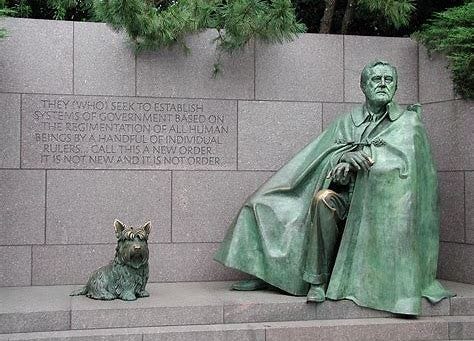
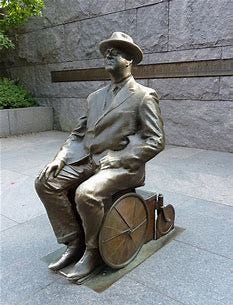
Wednesday, January 10, 2001. It was breezy, cold, and clear on Washington, DC’s National Mall as President Bill Clinton unveiled a life-sized bronze statue of former president Franklin Delano Roosevelt (FDR) seated in a wheelchair. The sculpture was a very late addition to the popular FDR Memorial that originally did not reveal his disability.
Like most city kids born “before air conditioning,” summer was not just hot and sweaty, it was scary. Even scarier than World War 2.
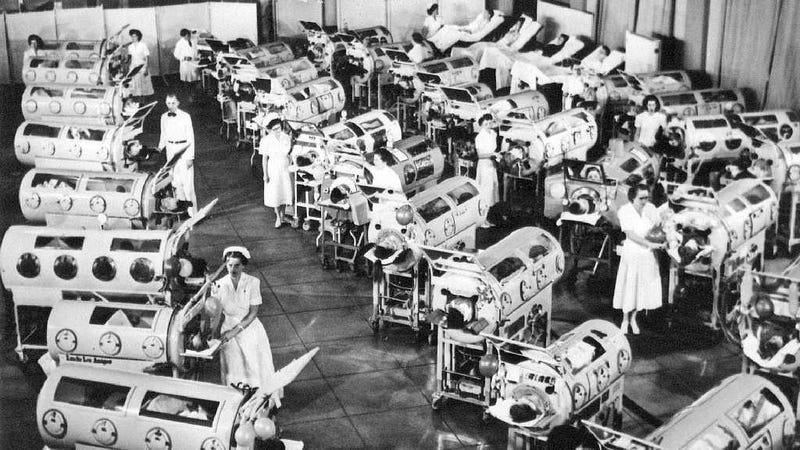
Debilitating and often deadly Polio was hiding in the atmosphere, in the pool water, on a store shelf, in the cool air of a theater. Was the girl across the streetcar aisle who just coughed going to infect me? My friends and I knew that Polio, quietly and randomly, was ready to strike, maim and kill, and that it also was named Infantile Paralysis.
Each summer’s Polio epidemic appeared to be worse than the last. Newspaper photos and then TV reminded us of the many children and a few adults clinging to lives in Iron Lungs to help them breath. Posters told us not to mix with new groups, not to get overtired or chilled, and to keep clean, especially to wash our hands.
It wasn’t until 1955, ten years after FDR died, that a vaccine to prevent Polio was available.
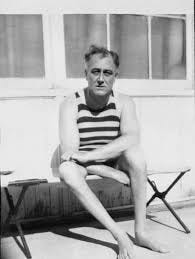
While FDR was open about being a Polio survivor he successfully concealed his skinny paralyzed legs from us. Roosevelt had to wear ten pounds of braces on those limp limbs (hidden by wide pants) to stand up. He could not walk, nor could he waddle, without strong people holding him up on each side, often they were his sons.
At that time, most people with severe disabilities were shamed, shunned, and sometimes hidden by their families. Even if they were smart, they were seen by many as mentally deficient.
That certainly wasn’t an attractive situation for an aspiring politician like Mr. Roosevelt. In part by hiding his paralysis, FDR went on to be Governor of New York and the US president.
The press totally covered up his disability and FDR was able to own his history for decades, even after his death.
Fast forward to the 1990s. As mentioned in the first essay on FDR’S WHEELCHAIR, one of my clients was the National Organization on Disability (NOD).
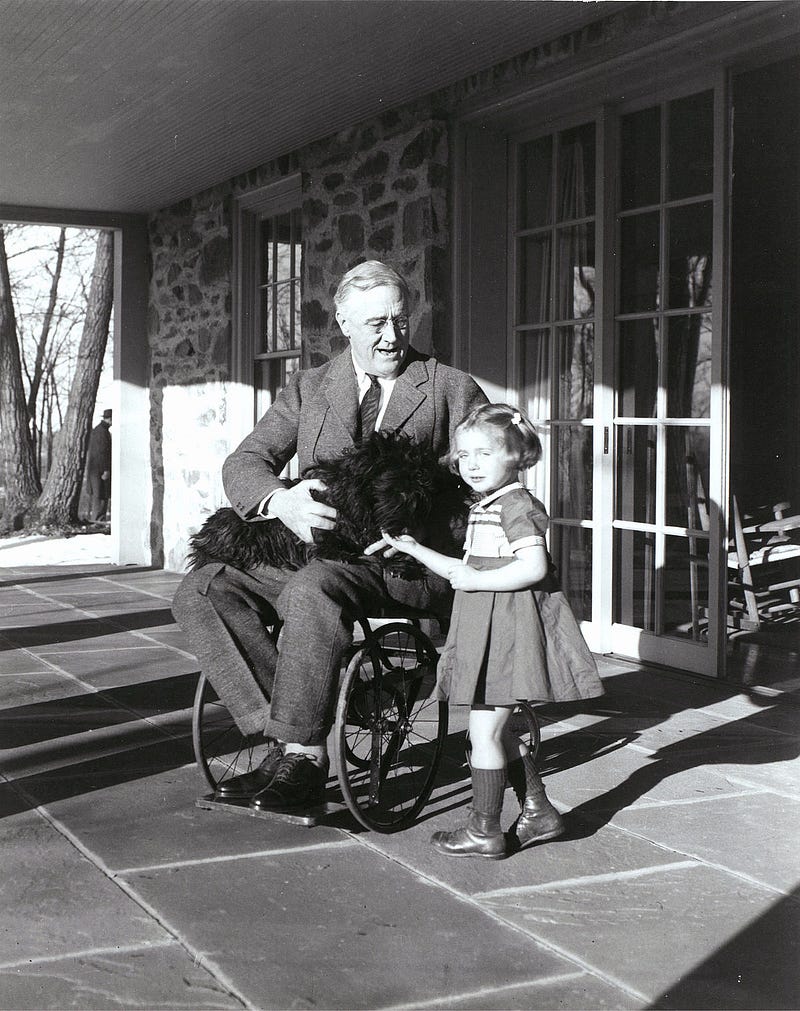
Forty years after President Roosevelt died, and after a lot of phone calls, I could locate but one photo of FDR in his chair and it hadn’t been published. The picture shows him, holding his dog Fala, and a little girl standing at his side. If you look online today you will find that very few FDR wheel-chair photos have since surfaced. Only this year (2018) a few home movies emerged.
NOD had commissioned surveys dealing with disability issues. They confirmed that most people with disabilities, whether severe or not, were depressed. Most didn’t seek education or jobs for which they were qualified.
As NOD’s communications consultant I was one of the strategists mulling over the best way to follow-up the surveys. The initial goal was to develop a nationwide campaign to encourage people with disabilities to seek jobs for which they were, or could become, qualified. We also sought a simple message for employers about the unexplored abilities within the disability community.
It was decided the FDR story was what we wanted to tell … the story we had to tell. And that he must be seen in a wheelchair to clearly illustrate his inspiring story and visually represent our motivational messages.
At that time there was a small buzz about a large FDR Memorial set to open in 1997 on the National Mall in Washington. There would only be one tiny indication that the man who led America out of The Depression and through WW2 did all that in a wheelchair. The hint would be behind a statue of him seated. FDR would be seen wearing the large cape he used to hide his wheelchair in public. If a visitor could squeeze around the back and look down, there would be two small casters peeking out that might indicate they were attached to his chair.
The NOD campaign to add a new statue, we hoped, also would open more positive discussions about disabilities than the highly divisive debate surrounding the 1990 Americans with Disabilities Act (ADA).
(Having earlier been deeply involved in national controversies, I cautioned that our little cabal was about to occupy the lead car of a wild roller coaster. Among them was, ZIP Code’s introduction in the 1960s, while AT&T was strongly pushing its all-digit dialing. This led citizens and editorial writers to claim we all would just be faceless numbers. Like FDR’s wheelchair, it also involved facts vs. emotions.)
One ambition was to accurately position NOD as being smack in the middle of the national and rational center. A slew of historians, men and women “on the street,” and editorial writers attacked NOD for going against a beloved leader’s wishes. It was hard to get traction because NOD did not include the activists who were eye-candy for TV and tabloids by yelling and chaining themselves and their wheelchairs to the White House fence.
Across the country, and especially when kids started sending small contributions, a minor momentum for the statue and an examination of disability issues emerged.
Then, unexpectedly, a steady stream of very senior print and broadcast reporters and columnists wanted to visit with NOD’s president Alan Reich, the chief architect of the strategy and tactics. Usually, they would rather humbly introduce themselves and tell him about a close friend or family member with a disability and that was the reason they sought to know more about the issues.
I think their reports and columns about the real problems and potential progress of their own and others’ kith and kin were what turned the tide. By the time a statue was commissioned NOD had raised over $1.5 million for the project.
FDR’s surviving family, however, posed a serious roadblock that took a huge amount of our time. To hide-or-not-to-hide, that was their question. To honor Franklin’s wishes or honor his grit and abilities while in that darned chair. For months there was no consensus. The Roosevelt family’s very public differences revolved around the question of “Who Owns History.” Eventually, most supported the statue and what it stood for.
Since Fake News has entered public discourse, the question of ownership of personal and governmental history is more relevant than ever. The typical answer is “the winners own history.” That probably was true in the past. But now, any individual or organization with a smart phone, can try to shape what others, or history itself, will think of them. (This essay, for instance.)
NOD won a battle, maybe it was just a skirmish, but the outcome was perceived as positive. Even though it took over a half decade between our first planning session and the statue’s arrival on The Mall, America and those with disabilities were inching forward.
Addenda
 “Once you’ve spent two years trying to wiggle one toe, everything is in       proportion.” — FDR, 1945
  1. Michael Deland, chair of the NOD’s board of directors, had worked in George H.W. Bush’s White House as chairman of the President’s Council on Environmental Quality. I remember, Deland saying, that the alterations made for Roosevelt made it a great working environment for a person like himself in a wheelchair. Michael did have a way with words.
  2. The atmosphere at NOD was alive with the sound of big thinkers. Three of the most able were in wheelchairs Reich, Deland, and Jim Brady (former Reagan spokesman, then a NOD VP). Also, weighing in was Bernie Posner who for a long time he had been the top federal bureaucrat dealing with disabilities. Through no fault of his own was Bernie was Steven Spielberg’s uncle.
  3. And Marty Walsh, a fundraiser and promoter previously with United Way of America. Marty sent me an email about his intelligence gathering. “I was able to talk my way into a secret office on the top floor of a Senate office building where the planning of the FDR Memorial was underway (and had been funded annually by the Senate since 1964). I posed as a curious out of town visitor wondering why there was no identification on the door … talked my way inside and saw the time line and layout of the Memorial (to be) built. There was no plan to show FDR in a wheelchair.”
  4. Another sharp strategist was NOD’s Ginny Thornburg. Her crusade to make places of worship more welcoming has brought brighter lights so attendees can read the prayer books, ramps used by people in or out of wheelchairs, and among other things, sound systems loud enough that parishioners can finally hear what the Hell is being said.
  5. Today, because of the ADA, common sense, and new attitudes, there are advances in the lives of people with and without disabilities. Among the minor benefits are; mothers pushing strollers into crosswalks use the curb ramps and no longer wake babies with a thump at every street corner, doors automatically open for fathers with hands full of grocery bags, emergency signs have large, readable type.
  6. While many disabilities may not be immediately evident, families, employers, and individuals are more open about them. Many businesses now are mining the mother-lode of previously hidden talents. I recently heard that, at one point, half of a huge west coast sportswear company’s in-house designers were dyslexic.
(end)

Sunday, August 5, 2018

Strive

poor georgie’s almanack:


Cartoon from 115 years ago. 
Immigration, we survived and thrived because of those who strived. 
And you we who forget history are doomed to repeat it, ever so painfully.

Sunday, July 29, 2018

ANTS

poor georgie’s almanack: 


After writing about bees, Teddy the Cal Tech maven asked about ants.  

OK. 

People who study bugs estimate the total weight of ants creeping around Earth at this very moment is about the same as the weight of all living humans.  


The estimated number of living ants has so many zeros it creeps me out. 

Saturday, July 28, 2018

Bees

poor georgie’s almanack:   


Bees are interesting.  A few random facts:

1.  Bee hives make decisions the same way human brains make them.  

2.  The once common Rusty Patch Bumblebee, now is endangered, going extinct.  Other bees are threatened.

4.  Bees both pollinate and predict.  For instance, Honeybees are European immigrants to America.  They arrived with early colonists along the Atlantic Coast and spread west ahead of settlers seeking to live off the land of milk and honey between the Appalachian and Rocky Mountains.  There, Native American medicine-men warned tribal leaders that the first sighting of a Honeybee meant white men would be appear over the horizon within three years. 


5.  To those of us who thought we might make the world a better place for our kids, today's kill-off of bees is just another sad reminder of the many ways we have failed.      

Sunday, July 22, 2018

WHAT IF IT IS A JOKE?

poor georgie’s almanack:

BUT WHAT IF IT’S A JOKE?  Yesterday, The Washington Post ran a story about the time, around 1840, when US President Martin van Buren was given two live lions, some horses, a Persian rug, and jewels by Mideast rulers.  The gifts set off one of the first really big emoluments-clause dilemmas.  To guard against conflicts of interest and potential bribes, people working for the government are pretty much forbidden to receive gifts and make profit from foreigners.  

Sometimes, it is not simple.  

For instance, The Post story reminded me of when daughter Amy and I were having lunch in Montevideo with the president of Uruguay, his wife, and daughter Pilar.  We, and a hand-full of others, were on the patio behind their government-supplied house.  Two llamas were roaming nearby.  


Amy’s college graduation present was to be my translator on a trip south of the Equator to present highly publicized awards to the first lady of Uruguay and the president of Argentina.  I was the volunteer president of the Pan American Development Foundation’s board of directors and had concocted a fund-raising and PR scheme to give awards to heads of state for working with the foundation on programs that helped their constituents lives.

Uruguay’s charming and very smart Mrs. Lacalle, though not the head of state, was a recipient for a nonprofit organization she led.  Some said it was Mrs. Lacalle who was responsible for her husband’s popularity.

Amy or I asked about the llamas.  The first lady said that, while in Paraguay for a summit meeting, the Lacalles heard a knock on their hotel room door.  It was opened and there in the doorway was Paraguay’s president with a rope in his hand.

He told them he knew there was a male llama in their back yard who must be lonely.  So his nation was giving them a female llama … which, of course, was on the other end of the rope, hopefully not soiling the rug.

I don’t think the emoluments clause of the US Constitution is a joke, nor are the potential legal problems of Mr. Trump’s family making money off of their foreign properties a triviality.  

But, how do legislators make laws that differentiate criminal activity from a couple of wise guys who like to pull practical jokes on each other? 


Tuesday, July 3, 2018

FDR'S WHEELCHAIR ... ESSAY #1

FDR’S WHEELCHAIR … ESSAY #1

A SUMMIT, A DETOUR ON THE WAY HOME, OIL, A FLYING SWIVEL SEAT, AND AN IMPULSIVE, HISTORIC ACT OF KINDNESS YOU PROBABLY NEVER KNEW.

It was Valentines Day, Wednesday, February 14, 1945.  The USS Quincy was anchored next to the USS Murphy in the Suez Canal's Great Bitter Lake.

Increasingly frail, exhausted and sick, the president of the United States of America was returning home after a long meeting in Crimea.  At Yalta,  Franklin Delano Roosevelt (FDR), Russia’s Joseph Stalin, and England’s Winston Churchill had made plans for the end of World War Two and decided which parts of Hitler’s Europe would be their own “spheres of influence.”

On his way home FDR’s ship had detoured into the Suez Canal for a round of summitry with Arab leaders. 

Two months later, Roosevelt would be dead.

But, on that Wednesday, during a five hour one-on-one, the gaunt but gritty FDR made a gesture of kindness and empathy to Saudi King Ibn Saud that changed history.   (Photo: Quincy meeting.)


I know about this because my client in the 1990s was Alan Reich.  Like FDR, he was confined to a wheelchair.  At age 32, Alan's neck was broken in a swimming accident.  His disability was more serious than FDR’s, whose legs were paralyzed at age 39 by Polio.  Reich was president of the National Organization on Disability (NOD).  Roosevelt and Reich clearly proved that people with disabilities surely have important abilities.

Alan wanted to create an annual award for heads-of-state celebrating their country’s efforts to improve the lives of people with disabilities.  The award would be in FDR’s name.  Reich, the UN Secretary General, and a major donor would jointly make the presentation.  The NOD’s founder and president already had hooked Boutros Boutros-Ghali the sitting Secretary General (SG), but he needed to reel in a bundle of money to support the award.

Reich asked me to be his sole traveling companion for a one-day trip to New York.  By then I was fairly adept at handling the intricacies of accompanying a virtual quadriplegic, getting in and out of wheelchairs, cars and planes.  The two of us visited the Saudi’s acting UN ambassador and then had a short session with the Boutros-Ghali.  

I had hastily located a photo of the historic 1945 meeting between FDR and Saudi King Ibn Saud.  The intent was for me to take a picture of Alan in his own wheelchair next to the ambassador holding the summit photo.  We then could tell our story in a short caption. 

The ambassador’s visit was part of Alan’s campaign to raise $5 million from the desert nation for the award.  Alas, the Saudis had no interest.  The FDR award eventually was delivered to a few heads of state in a rather subdued manner with meager funding from elsewhere.  But, that’s background noise for this essay.

Later, when I had time to research the FDR/Saud session, what a story that photo revealed! 


The Arabian Peninsula floats on a sea of oil.  Several nations wanted to get their hands all the way into it.  But, Ibn Saud, the wily desert fighter who created the nation he led, could be as slippery as the oil.  

Sometimes he was a ruthless throwback to all-powerful god-fearing feudal and nomad kings.  Even as a head of state Ibn Saud often lived in tents, had relatively few modern conveniences, but was quite attracted to the US Dollar or any hard currency to fuel his dreams.  At that time Saudi Arabia was a desperately poor nation making more money from pilgrims visiting Mecca than any other source.   

Separately, moving FDR through Nazi submarine-infested waters was a major mission.  An armada of Navy ships and dozens of warplanes were involved in the trip to Yalta and back, including the Suez detour.   

One vessel was the USS Murphy.  For five days, it was home to  the King and his 48-person entourage of servants, cooks, an astrologer, food taster and barefoot body guards, plus a small herd of goats to be skinned and cooked following Islamic dietary traditions.  A group of the King’s wives and harem, originally scheduled for the trip, remained in Saudi Arabia.  Navy brass nixed having all those women onboard for the Jeddah - Suez round trip.  (Map: Jeddah, bottom right, Suez upper left.  It's a two night trip on a warship.)


During this first foray on a motorized ship, Ibn Saud slept in a large tent erected on the Murphy’s forward outside deck.  Sailors, of course, nicknamed the destroyer “Big Top.”   

Angelo Marinelli, a seaman on the mission, said, “They built campfires on the deck of the destroyer.  Every sailor aboard was carrying a fire extinguisher in case the fires in the tents got out of hand.”

Ibn Saud suffered severe pain while walking.  Ship decks were carpeted to alleviate some of the King's discomfort.  He and FDR famously bonded, in large part because of their disabilities, during what for the increasingly infirm FDR was a marathon ordeal. The King, whose cane is visible in the photo, had never seen such a chair and was fascinated.  

In what historians report was an impulsive act, FDR gave Ibn Saud his backup chair.  This was a bigger deal than the planned gift of a  fully-manned DC-3 passenger plane with a swivel seat.  Thus, while in the air, the King could painlessly turn to Mecca to pray.


After discovering that the thin wheels of FDR’s chair didn’t work in sand the monarch had several constructed with wide wheels.  

Like in affairs of the heart, kindness and empathy can be a warm glue that tempers cold hearted pragmatism.

###

Personal aside:  My enthusiasm for Reich’s idea was quite real.  At that time I also was the volunteer president of the Pan American Development Foundation’s board of directors.  Earlier I had a similar idea dealing with heads of state in the Americas, although disability programs were not on the Foundation’s agenda. 

The PADF awards had worked well … sometimes embarrassingly well.  The Brazilian Secretary General of the Organization of American States (the hemisphere’s UN) was a usually jovial Brazilian named Baena Soares.  He and I once were in Mexico City to present an award to the country’s president.  To my embarrassment, a major newspaper published a front page photo above the fold of the ceremony mis-identifying me as the SG.  We sort of looked similar … glasses, bald, short, wide of girth.  Fortunately, he thought it was humorous.

More about FDR’s wheelchair to come later in Essay #2 … “WHO OWNS HISTORY?”